Why Samples Differ From Bulk Orders

Understanding the Difference Between Sampling and Mass Production
One of the most common questions we receive from buyers is:
"Why does the bulk order look slightly different from the approved sample?"
For many first-time buyers, this can be frustrating. However, in professional manufacturing, a small difference between samples and bulk production is sometimes normal.
The important question is whether the differences are within the agreed quality standard.
Understanding why these differences happen can help buyers communicate more effectively with their suppliers and avoid unnecessary disputes.
1. Samples Are Often Made Under Different Conditions
A development sample is usually produced individually by an experienced technician.
More time is spent on:
- Machine adjustment
- Yarn tension
- Stitch correction
- Manual inspection
During bulk production, hundreds or thousands of pairs are produced continuously. Even with the same machine settings, production efficiency becomes an important factor.
This is why a factory should always define an acceptable production tolerance before mass production starts.
2. Yarn Lots May Not Be Exactly the Same
Even when using the same material specification, different yarn batches can have slight variations in:
- Color shade
- Elastic recovery
- Surface texture
Professional manufacturers inspect incoming materials before production, but small differences between dye lots are common throughout the textile industry.
3. Machine Settings Are Optimized for Mass Production
During sample development, machines are adjusted to achieve the target design.
Before bulk production, engineers often fine-tune machine settings to improve:
- Production stability
- Compression consistency
- Yield rate
These adjustments should never change the product specification, but they may create slight visual differences.
4. Compression Socks Require Size Grading
Unlike ordinary socks, medical compression socks are produced in multiple sizes with different knitting parameters.
For example:
- S
- M
- L
- XL
Each size has its own compression calculation to maintain the required pressure level.
A sample made in one size cannot perfectly represent every production size.
5. Packaging May Change After Sample Approval
Many buyers approve a product sample before final packaging is completed.
Later, bulk production may include:
- Private label packaging
- Retail boxes
- New barcode labels
- Country-specific instructions
These changes affect the presentation of the product but not its manufacturing quality.
6. The Importance of an Approved Production Standard
Experienced buyers do not rely only on a physical sample.
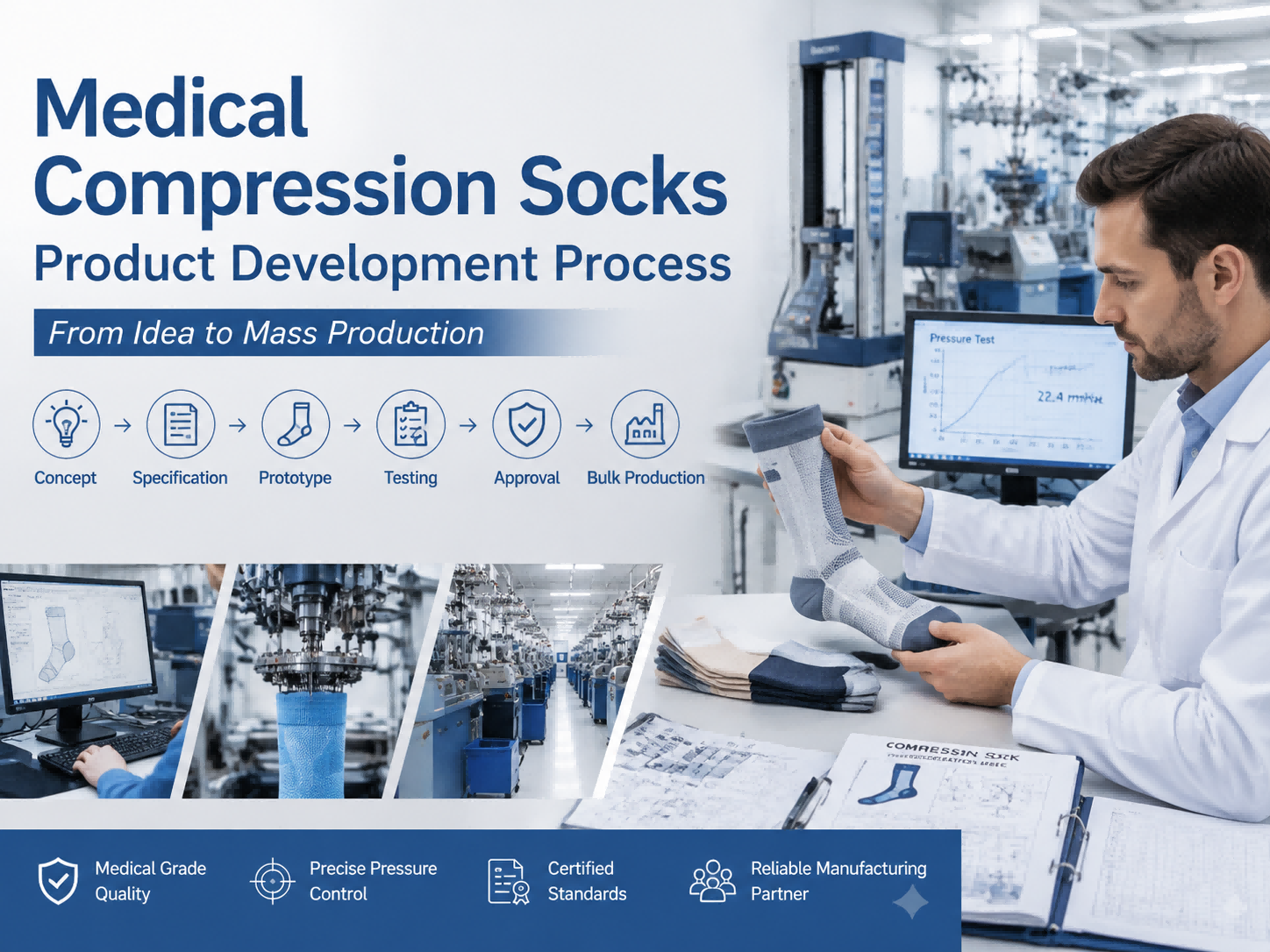
Before bulk production, they confirm a complete specification, including:
- Compression level (mmHg)
- Size chart
- Material composition
- Color reference
- Logo position
- Packaging details
- Inspection standard
A clear production standard helps both the buyer and the factory evaluate whether the bulk order meets expectations.
A Common Mistake Buyers Make
Some buyers compare the bulk order only with the original sample by appearance.
However, for medical compression socks, the key factors should always be:
- Compression performance
- Size consistency
- Material quality
- Overall workmanship
Minor visual differences that do not affect performance are generally acceptable within agreed manufacturing tolerances.
Final Thoughts
Samples and bulk orders serve different purposes.
A sample proves that the design can be achieved. Bulk production proves that the product can be manufactured consistently at scale.
The goal of a professional manufacturer is not to make every pair identical to the sample by hand, but to ensure every production batch meets the approved specifications and quality standards.
Looking for a Reliable Compression Socks Manufacturer?
We help brands and distributors reduce production risks through:
- Professional sample development
- Stable bulk production
- Medical-grade quality control
- OEM & ODM services
- Consistent compression performance
Compression Socks Lead Time Explained
How Compression Socks Are Made Factory Guide
Related Article