Private Label Compression Socks Profit Guide
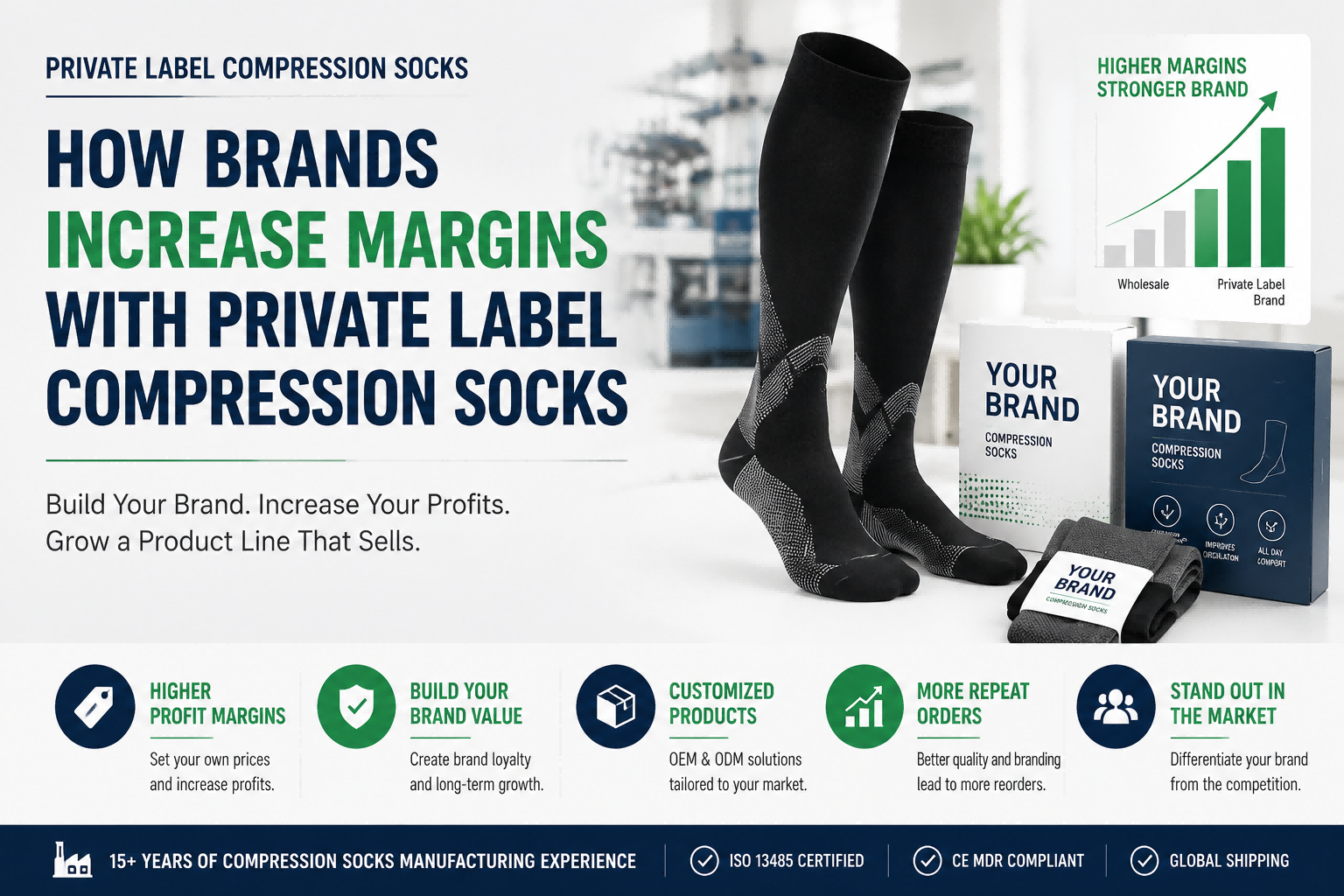
A Practical Guide for Importers, Distributors, and Medical Brands
In the compression socks industry, we’ve noticed a clear shift over the past few years.
More and more buyers are moving away from generic wholesale products and starting their own private label brands.
The reason is simple:
Private label gives you control — over pricing, branding, and long-term profit.
From a manufacturing perspective, the difference is not just branding. It directly affects your margins and how scalable your business becomes.
1. Why Private Label Improves Profit Margins
When you buy wholesale compression socks, you are usually competing with the same product in the same market.
That means:
- Price competition is intense
- Margins are limited
- Differentiation is almost impossible
With private label, the situation changes completely.
You are no longer selling a “product type” — you are building a brand product.
This allows you to:
- Set your own retail pricing
- Avoid direct price comparison with competitors
- Build repeat customers under your brand
- Increase perceived value through packaging and positioning
In most cases, brands can achieve significantly higher margins simply by moving from wholesale to private label.
2. A Common Growth Path We See from Buyers
From our experience working with importers and Amazon sellers, most successful brands follow a similar path:
Step 1: Start with ODM for market testing
They choose ready-made designs such as:
- 15–20 mmHg daily compression socks
- 20–30 mmHg medical support socks
At this stage, the goal is not differentiation — it’s speed.
They want to test:
- Which compression level sells better
- Which market responds faster
- What price range customers accept
Step 2: Move into OEM customization
Once sales stabilize, they start upgrading to OEM development:
- Custom knitting patterns
- Brand colors
- Logo placement
- Private packaging design
This is usually where margins start to improve noticeably.
Step 3: Build a product range
Instead of selling one product, brands expand into categories such as:
- Medical compression socks
- Travel compression socks
- Sports recovery socks
- Diabetic socks
A structured product line increases average order value and repeat purchases.
3. Where Margins Are Actually Created
Many buyers think margins come from “lower factory prices.”
In reality, that’s only part of the picture.
From a manufacturing point of view, profitability is usually determined by:
Material selection
Different yarn combinations create different positioning:
- Nylon + Spandex → standard medical compression socks
- Bamboo blends → comfort-focused retail products
- Silver fiber → premium medical segment
Each material impacts both cost and perceived value.
Knitting technology
- Circular knitting → efficient, cost-effective production
- Flat knitting → advanced shaping and medical-grade customization
Choosing the right structure helps avoid over-engineering or under-positioning the product.
MOQ planning
Brands that plan production properly usually achieve better unit costs.
For example:
- Consolidating SKUs
- Planning seasonal orders
- Aligning packaging across product lines
These decisions often matter more than small unit price differences.
4. A Real Situation We See Often
One of the most common cases we see:
A buyer starts with a generic compression sock from multiple suppliers.
At first, sales look fine.
But over time, problems appear:
- Price competition increases
- Margins shrink
- Customer loyalty is low
When they switch to private label, the situation changes:
- Pricing becomes more stable
- Repeat orders increase
- Brand recognition improves
- Profit per unit goes up
The product stays the same — but the business model changes.
5. Why Private Label Works in This Market
Compression socks are not a trend product. They are a repeat-use healthcare product.
That means:
- Customers reorder regularly
- Trust matters more than price
- Brand credibility directly impacts sales
Private label allows buyers to capture that long-term value instead of competing in short-term price wars.
Final Thoughts
Private label compression socks are not just a sourcing option — they are a business strategy.
The real advantage is not only higher margins, but also:
- Brand ownership
- Customer retention
- Long-term market positioning
For most importers and distributors, the transition from wholesale to private label is where real growth begins.
Looking for a Private Label Compression Socks Manufacturer?
We work with global brands and distributors to develop:
- Private label compression socks
- OEM & ODM product development
- Custom packaging and branding
- Medical-grade production standards
- Flexible MOQ for market testing
US Brand Compression Socks Case Study
Why Compression Socks Are Growing Fast
Related Article