
How to Verify a Compression Socks Factory Quality Before Placing Your First Order
author: Carol
2026-05-20

For any B2B buyer—whether you are a clinic, retailer, medical brand, or e-commerce seller—finding a trustworthy compression sock manufacturer is a critical first step. Selecting the wrong supplier can lead to a host of issues, ranging from inconsistent compression levels and customer returns to shipping delays and even regulatory compliance issues. So, before placing your initial order, how can you effectively identify a truly reliable partner amidst the multitude of available manufacturers?
The following guide provides a practical, step-by-step framework to help you effectively verify the product quality of compression sock manufacturers. This guide is based on real-world factory audit cases and industry best practices in procurement.
The following guide provides a practical, step-by-step framework to help you effectively verify the product quality of compression sock manufacturers. This guide is based on real-world factory audit cases and industry best practices in procurement.
1. Check the Factory's Credentials: The Non‑Negotiables
Before discussing pricing or Minimum Order Quantities (MOQ), be sure to request the factory's quality certification documents. The following documents serve as strong evidence that the factory operates in a standardized and compliant manner:
- ISO 13485 — The international standard for quality management systems for medical devices.
- CE Marking (Class I Medical Devices) — This certification is mandatory if you intend to sell compression socks as medical products within Europe.
- FDA Registration — This registration is required if you plan to sell the socks as medical devices in the United States.
- OEKO-TEX® Standard 100 — Certifies that the raw materials used are free from any harmful substances.
- BSCI or SMETA Audit Reports — Demonstrates that the factory complies with relevant standards regarding business ethics and social responsibility (a crucial requirement for many Western retailers).
A legitimate and responsible factory will be happy to provide copies of the aforementioned documents. If they appear hesitant to do so, or claim they can only provide them "at a later time," consider this a major red flag.
2. Ask for Third‑Party Test Reports – Not Just Their Word
Even if the product comes with a certificate, you should still review the specific batch-specific test reports issued by an independent laboratory. Please request the following reports:
- Compression Test Report (e.g., tests conducted using Kikuhime or MST MK-IX devices)—the report should display the graduated compression values (e.g., 20–30 mmHg at the ankle, 15–20 mmHg at the calf, and 10–15 mmHg at the knee).
- Fabric Composition Test Report—used to verify the ratio of nylon to spandex (typically, for medical-grade products, the ratio is 65–75% nylon / 25–35% spandex).
- Dimensional Stability and Wash Durability Test Report—evaluates the degree of attenuation in the product's compression values (elasticity) after 5, 10, or 20 wash cycles.
- Skin Irritation/Sensitization Test Report—such reports are essential if the product makes claims regarding medical efficacy.
If the factory is unable to provide recent third-party test reports, please ask if they can arrange for a pre-shipment inspection by agencies such as SGS, TÜV, or Intertek. Quality-conscious factories are typically happy to accommodate such arrangements.
3. Request Samples – And Test Them Like a Pro
Never place a bulk order without first evaluating samples. Please order at least 3 to 5 samples of varying sizes and pressure ratings. The following items require inspection:
Visual and Tactile Inspection
- Knitting Uniformity — Free of loose threads, uneven stitches, or dropped stitches (laddering).
- Seams — Flat, smooth, and secure; free of rough edges that could irritate the skin.
- Toe Closure— For closed-toe styles, the toe seam should be comfortable and free of any constrictive pressure.
- Fabric Texture— Soft and elastic; free of itchiness or excessive sheen.
Compression Consistency Test (Internal Assessment)
You do not need a professional laboratory to gain a general understanding of the compression distribution. Place the socks over a graduated cylinder or a leg-shaped mold and measure the pressure using a simple pressure gauge (if available), or simply wear them on your own legs for a subjective comfort test. Ideally, the sensation of tightness should be strongest at the ankle and gradually diminish as it extends upward toward the calf. If the tightness feels uniform across all sections, the product is likely not a true "graduated compression" sock.
Wear and Wash Simulation Test
Please wash the samples strictly according to the care instructions (hand washing in cold water and air drying are recommended). After 5 wash cycles, please inspect the following:
- Has pilling occurred, or has the elasticity diminished?
- Has the sensation of compression (tightness) noticeably weakened?
- Has any fading or color bleeding (dye transfer) occurred?
4. Visit the Factory or Request a Live Video Audit
On-site audits are undoubtedly the "gold standard" in the industry; however, if you are unable to visit in person, conducting a factory tour via live video serves as an excellent alternative. During the tour, please pay particular attention to the following aspects:
- Knitting Machinery—Reputable factories typically utilize machines from brands such as Germany's Merz, or Italy's Santoni and Lonati. Inquire about their total equipment inventory (for instance, possessing more than 50 machines usually indicates a significant production scale).
- Quality Control Stations—Observe whether workers are actively engaged in defect detection, length measurement, and pressure testing on randomly sampled products.
- Cleanliness and Layout—Cluttered floors or tangled yarn often serve as indicators of poor factory management.
- Warehousing and Packaging Areas—Proper storage conditions (such as avoiding direct sunlight and controlling humidity) help prevent the deterioration or loss of raw materials.
During the video call, be sure to request a conversation with the factory's Quality Manager, and ask them for specific details regarding product defect rates and their procedures for handling customer complaints.
5. Verify Their Graduated Compression Capability – The Hardest Part
Many inexpensive socks claim to offer "compression" features, but in reality, they are merely tight—which can be dangerous (as this may impede blood circulation in the lower legs). To verify whether a product provides genuine "graduated compression," please take the following steps:
- Request pressure distribution charts for each of their flagship products (e.g., those with compression levels of 15–20, 20–30, or 30–40 mmHg).
- Request that they conduct actual measurements on product samples using their in-house testing equipment (most reputable factories are equipped with specialized instruments such as the Kikuhime or Salzmann MST-MK-IX).
- If feasible, send samples yourself to an independent third-party laboratory for testing (at a cost of approximately $100 to $200)—compared to the potential loss of thousands of dollars resulting from a defective batch, this testing fee represents a truly minor investment.
Furthermore, inquire about how they calibrate their testing equipment and how frequently this calibration is performed. If they appear bewildered by this question, it serves as a significant warning sign that warrants caution.
6. Investigate Their Material Sourcing
The quality of compression socks begins with the yarn. When communicating with a factory, be sure to ask the following questions:
- Where do you source your nylon and spandex raw materials? — Top-tier industry suppliers include Invista (owner of the Lycra® brand), Hyosung, Asahi Kasei, and Toray.
- Do you use certified Lycra® fibers, or generic spandex? — Compared to generic alternatives, Lycra® fibers offer not only reliable quality assurance but also superior elasticity and recovery properties.
- Do you have an incoming raw material inspection process in place? — Reputable factories should rigorously test every batch of yarn to verify its denier count, tensile strength, and color consistency.
If a factory opts for inferior spandex, the socks they produce will often lose their shape and elasticity rapidly after just a few washes, ultimately leading to disappointment for the end user.
7. Ask About Their Quality Control Plan for Your Order
Before placing an order, it is essential to clearly define the acceptance criteria in writing. Key points to address include:
- AQL (Acceptable Quality Limit) — for example: a limit of 2.5% for critical defects and 4.0% for minor defects.
- Inspection Stages — In-process inspections (i.e., checks conducted during the knitting production phase), as well as final random inspections prior to packaging.
- Defect Classification — Clearly defining what constitutes a critical defect (e.g., insufficient compression pressure, holes, incorrect dimensions) versus a minor defect (e.g., slight color variations, loose threads).
- Third-Party Inspection — Reaching a mutual agreement that permits you to commission a third-party agency—such as SGS or TÜV—at your own expense to conduct pre-shipment inspections (with the factory’s full cooperation).
A professional factory will typically maintain a standard Quality Control (QC) checklist and will be happy to share it with you.
Conclusion: Quality Verification Is an Investment, Not a Cost
Spending several weeks vetting a compression sock factory might seem like unnecessary extra work at first glance; in reality, however, it can spare you months of headaches, product return disputes, and the risk of customer churn. A truly high-caliber factory will not only maintain complete transparency regarding its certifications but will also be eager to provide samples and readily welcome independent third-party inspections.
At Compports, we welcome such scrutiny. We specialize in the professional manufacturing of medical-grade graduated compression socks and hold numerous prestigious certifications, including ISO 13485, CE, and OEKO-TEX®. Leveraging our advanced Merz knitting machinery and our proprietary in-house compression precision testing system, we ensure that every single batch of products precisely meets its stated mmHg compression level standards. We invite you to contact us at any time to request samples or to schedule a "virtual factory tour"—allowing you to verify our exceptional quality firsthand.
Factory vs. Trading Company: How to Verify Your Chinese Compression Sock Supplier
Compports Medical Socks B2B Partnerships
Related Article

Learn what medical brands need to know before launching compression stockings, including compression classes, product types, knee high, thigh high, pantyhose, open toe and closed toe options.
What Medical Brands Should Know Before Launching Compression Stockings
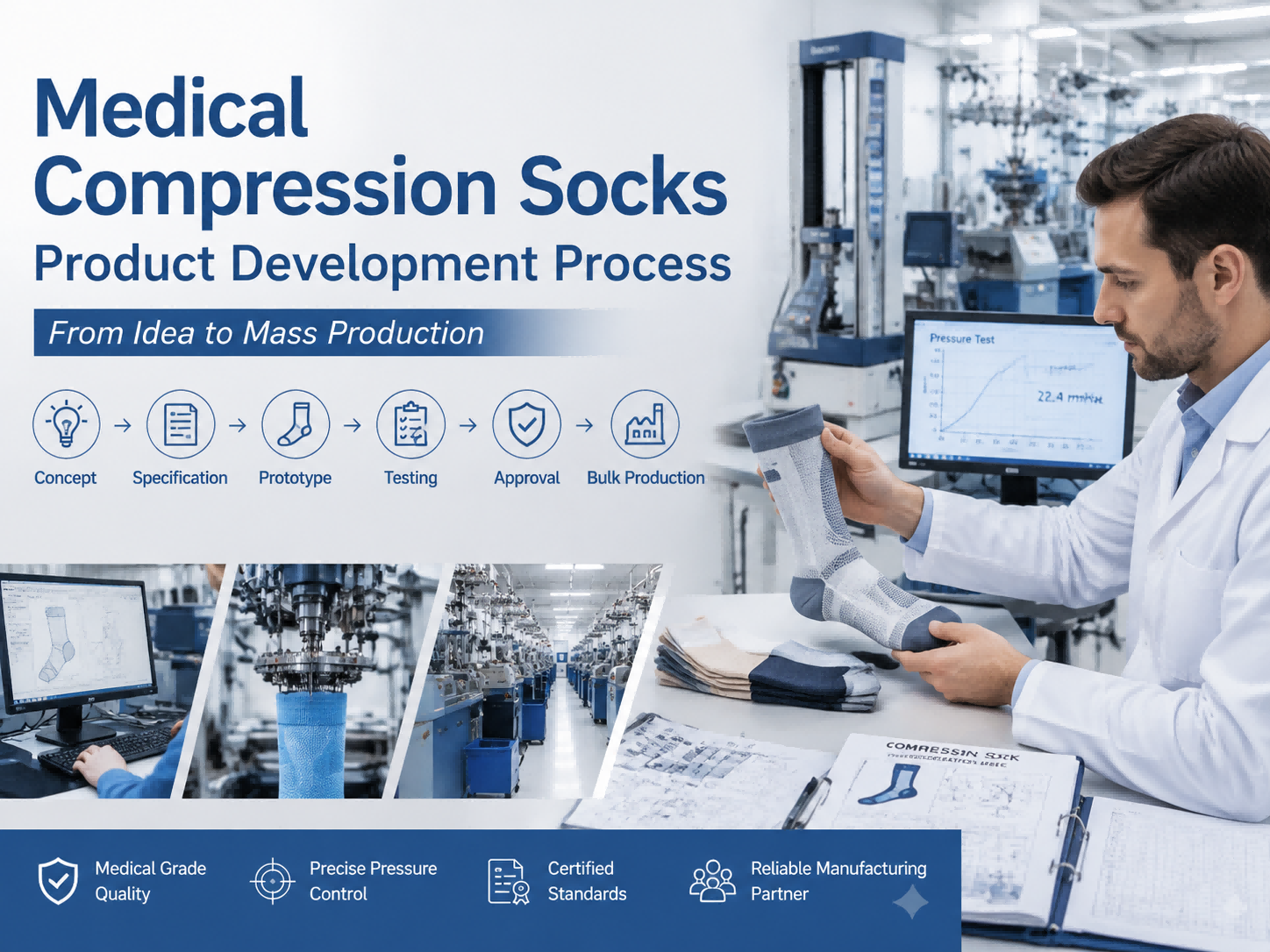
Learn how medical compression socks are developed from concept to mass production. This guide explains each step, including specification design, prototype development, testing, approval, and manufacturing for healthcare companies and medical brands.
Medical Compression Socks Product Development Process
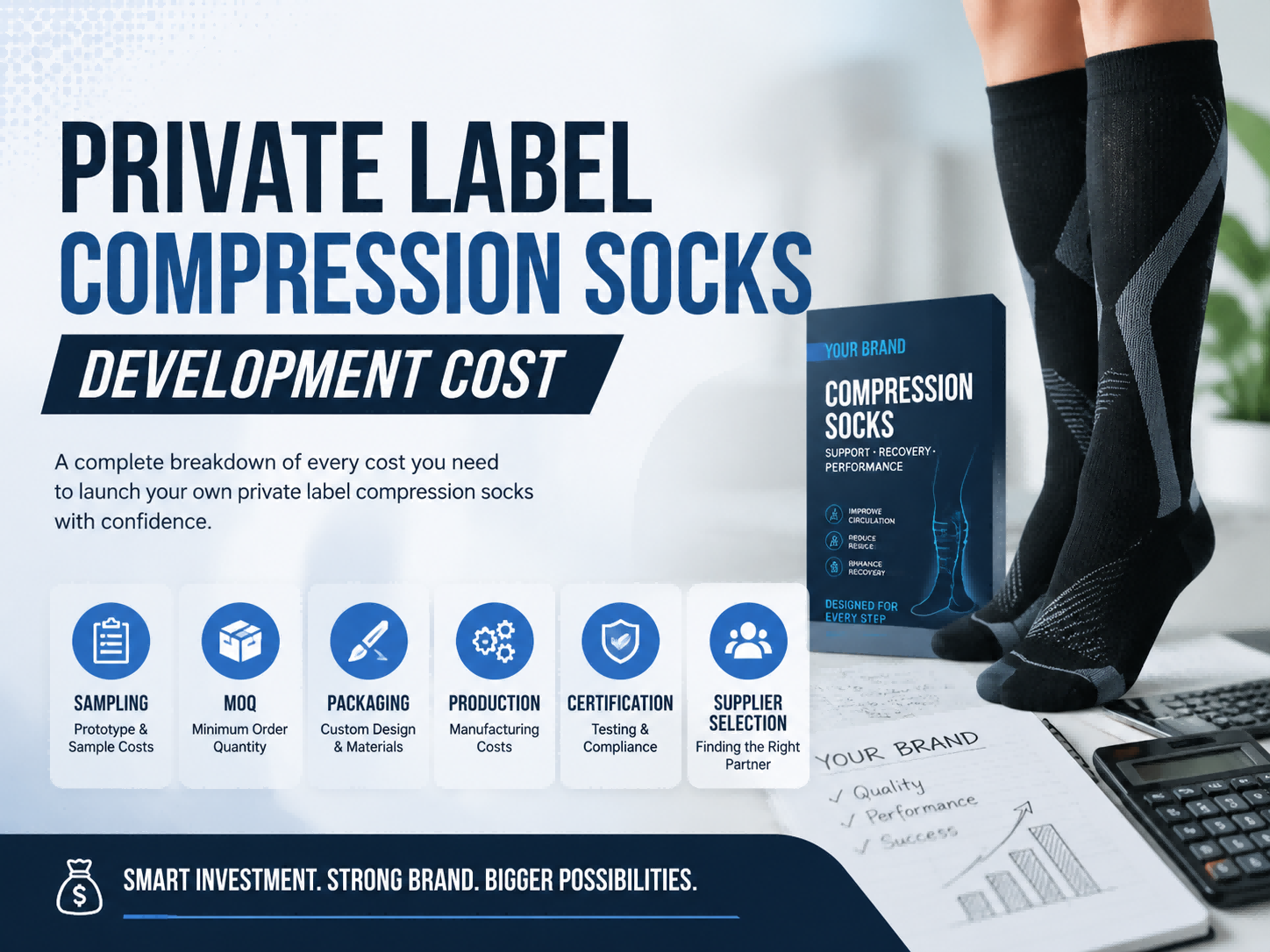
Learn how much it costs to develop private label compression socks, including sampling, MOQ, packaging, production, certification, and supplier selection.
Private Label Compression Socks Development Cost

Starting a compression socks brand requires more than selecting a product. This guide covers the key steps from market research and product selection to supplier sourcing, sampling, branding, and launch preparation. Learn how Amazon sellers, distributors, and healthcare startups can build a reliable compression socks business with the right manufacturing partner and product strategy.
How to Build a Compression Socks Brand in 2026