How to Avoid the Most Costly Mistakes When Sourcing Compression Socks from China

Unlike regular socks, compression stockings are functional textiles subject to stringent regulations. Any oversight regarding yarn tension or graded certification can lead to customs seizures, negative consumer reviews, or even catastrophic product recalls.
Below are four of the most common costly mistakes global buyers make when sourcing compression stockings, and how to protect your supply chain from these errors.
Mistake1: Accepting "Flat" Pressure Instead of True Graduated Compression
The biggest mistake is treating compression stockings like athletic tights. True compression stockings require progressive pressure—the pressure must be highest at the ankle (100%) and gradually decrease upwards to the calf (e.g., 70% in the mid-calf and 40% in the thigh).

The Risk:
Many ordinary sock factories claim a sock compression of "20-30 mmHg," but lack the specialized equipment (such as German Merz or Italian Lonati circular knitting machines) and software to set the pressure gradient. They simply reduce the sock size or use tighter elastic bands. This creates a dangerous "tourniture effect," restricting blood flow instead of promoting circulation.
How to Avoid It:
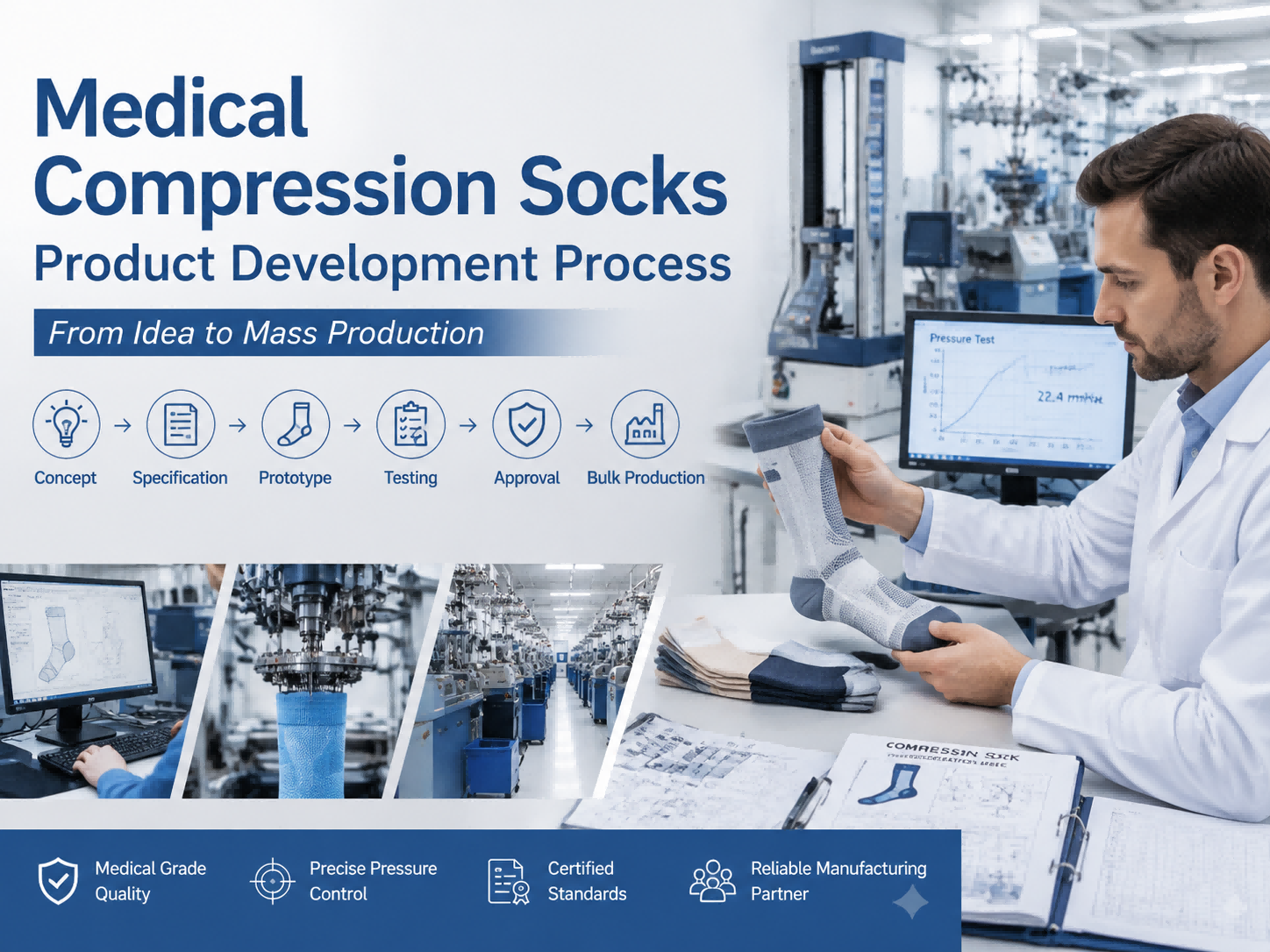
Do not rely solely on visual inspection or touch to determine the correct reading. Always request a Salzmann test report or an MST (Medical Compression Stocking Tester) report from the manufacturer. Professional OEM factories conduct batch testing using Swiss-made Salzmann Swiss-Tech equipment before shipment to verify precise mmHg values for specific anatomical locations.
Mistake 2: Ignoring raw material losses and hidden yarn costs
The Risk:
-
Hidden material costs: Some factories will quote low prices using cheap, general-purpose polyester/spandex blended fabrics. Once you request medical-grade coated yarns (such as premium nylon 66 or specialized antibacterial yarns), they will suddenly and drastically increase the price before production, catching you off guard.
-
The "Smell and Skin" Trap: Inferior synthetic yarns can leave a strong chemical odor or cause skin allergies, damaging your brand reputation.
How to Avoid It:
In your initial request for quotation (RFQ), please clearly define your yarn specifications (e.g., double-coated Lycra/Nylon 66). Ensure your supplier holds OEKO-TEX Standard 100 or REACH compliance certification to guarantee the material is safe for direct, prolonged skin contact.
Mistake 3: Ignoring comfort: Seamless toe box vs. bulky seams
The Risk:
Because compression socks fit snugly against the skin, the thick gaps between the toes can compress the toes, causing pain, friction, blisters, and prompting immediate customer returns—especially among diabetics or elderly users.
How to Avoid It:
Please specify "seamless toe construction" or "hand/automatic toe stitching" in the technical data package. High-end factories use integrated automatic toe stitching technology directly on their knitting machines (such as Lonati's SbyS—one-needle-by-one stitching system). This technology creates completely smooth, friction-free seams, ensuring medical-grade comfort.
Mistake 4: Missing the Dynamic Lead Time & Regulatory Bottlenecks

The Risk:
How to Avoid It:
Partner with a manufacturer that has export experience and understands international customs compliance regulations. Confirm that they can proactively schedule production and have pre-registered a compliance framework for your target market to ensure a smooth, zero-delay customs clearance process.
The Bottom Line
Sourcing functional hosiery requires experienced partners, not just standard production lines. By demanding certified pressure test reports, superior flat-toe construction, and premium certified yarns, you can protect your brand from costly quality claims and build a high-profit, sustainable product line.
Partner with a Certified Compression Hosiery Expert
Compression Socks vs. Medical Stockings: The Ultimate B2B Sourcing Guide for Brands & Retailers
Minimum Order Quantity (MOQ) Guide for Compression Socks: What B2B Buyers Should Know
Related Article