Choosing the Best Sourcing Model for Your Compression Socks
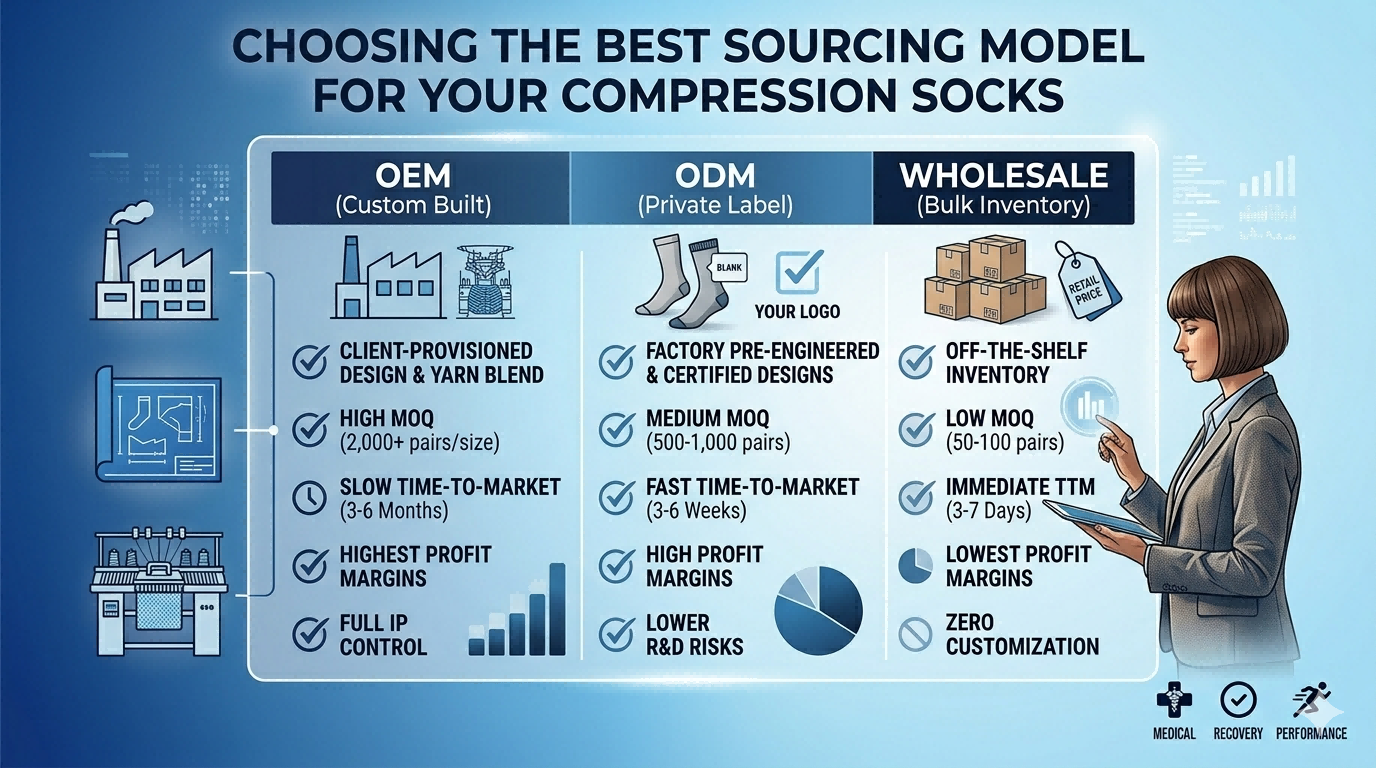
1. OEM (Original Equipment Manufacturing): Pure Custom Manufacturing
Concept: You provide the precise blueprint, material technology (e.g., a specific Lycra/nylon ratio), and graded pressure profiles. The manufacturer acts solely as the production engine, weaving exactly to your specifications.
-
Best For: Established medical brands, hospital groups, and sports apparel lines with internal product development teams.
-
Advantages: Absolute control over intellectual property, yarn selection, and branding details. Offers the lowest per-unit cost at mass scale.
-
B2B Limitations: High Minimum Order Quantities (MOQs), extended lead times, and all development/compliance risk falls on your shoulders.
2. ODM (Original Design Manufacturing): Full-Service Sourcing
Concept: The manufacturer has pre-designed, tested, and certified a variety of compression sock styles, ready for immediate use. You can choose from their established templates and add your own logo, packaging, and color scheme.
-
Best For: E-commerce brands, maternity labels, and retail startups wanting to launch high-performance compression wear without high R&D costs.
-
Advantages: Rapid time-to-market. The factory has already invested in Swiss/German pressure-testing (e.g., Salzmann testing) and machinery calibration, guaranteeing functional performance right out of the box.
-
B2B Limitations: Reduced product uniqueness. Competitors may source the exact same base sock structure from the same supplier.
3. Wholesale / Direct Bulk Buying: Instant Inventory
Concept: Purchase existing brand inventory directly from suppliers or manufacturers. No custom or private label production is involved.
-
Best For: Independent medical supply stores, local pharmacies, and regional distributors looking to fill immediate inventory gaps.
-
Advantages: Lowest risk, lowest lead times, and ultra-low MOQs (often just one carton).
-
B2B Limitations: Very low profit margins, fierce price competition with other resellers, and zero brand equity creation.
Technical Comparison Matrix for Product Managers
| Evaluation Metric | OEM (Custom Built) | ODM (Private Label) | Wholesale (Off-the-Shelf) |
| R&D & Design Input | 100% Client Provided | Factory Blueprint + Client Logo | Zero Input (100% Pre-made) |
| Time-to-Market | Slow (3−6 months) | Fast (3−6 weeks) | Immediate (3−7 days) |
| MOQ Requirement | High (e.g., 2,000+ pairs/size) | Medium (e.g., 500−1,000 pairs) | Low (e.g., 50−100 pairs) |
| Profit Margins | Highest | High | Lowest |
| Regulatory Risk | Client bears responsibility | Factory shares certification data | Fully reliant on existing brand |
Decision Framework: Which Strategy Fits Your Brand?
-
Choose OEM if: You discovered a proprietary yarn blend or a patented foot-bed architecture and want to defend that market edge with high-volume production.
-
Choose ODM if: You want to quickly enter the profitable "daily travel" or "maternity recovery" compression market with a premium product, avoiding the expensive trial-and-error of machine calibration.
-
Choose Wholesale if: You are a local retail outlet testing consumer demand for compression products before launching your own brand.
How to Customize Your Own Compression Socks Brand
Open Toe vs. Closed Toe Compression Socks: Which Is Right for Your Product Line?
Related Article