Minimum Order Quantity (MOQ) Guide for Compression Socks: What B2B Buyers Should Know

When you inquire with manufacturers, the MOQ quotes you receive can vary wildly—from 50 pairs to 3,000 pairs per style. Why such a large gap? Understanding the engineering and production logic behind these figures will help you optimize your sourcing budget, avoid inventory buildup, and negotiate effectively with suppliers.
1. The Core Logic Behind Compression Socks MOQ
Unlike regular casual socks, compression socks are functional textiles, categorized as medical devices or high-performance sportswear. Their minimum order quantity is not arbitrarily set by the factory, but is closely related to production configuration.
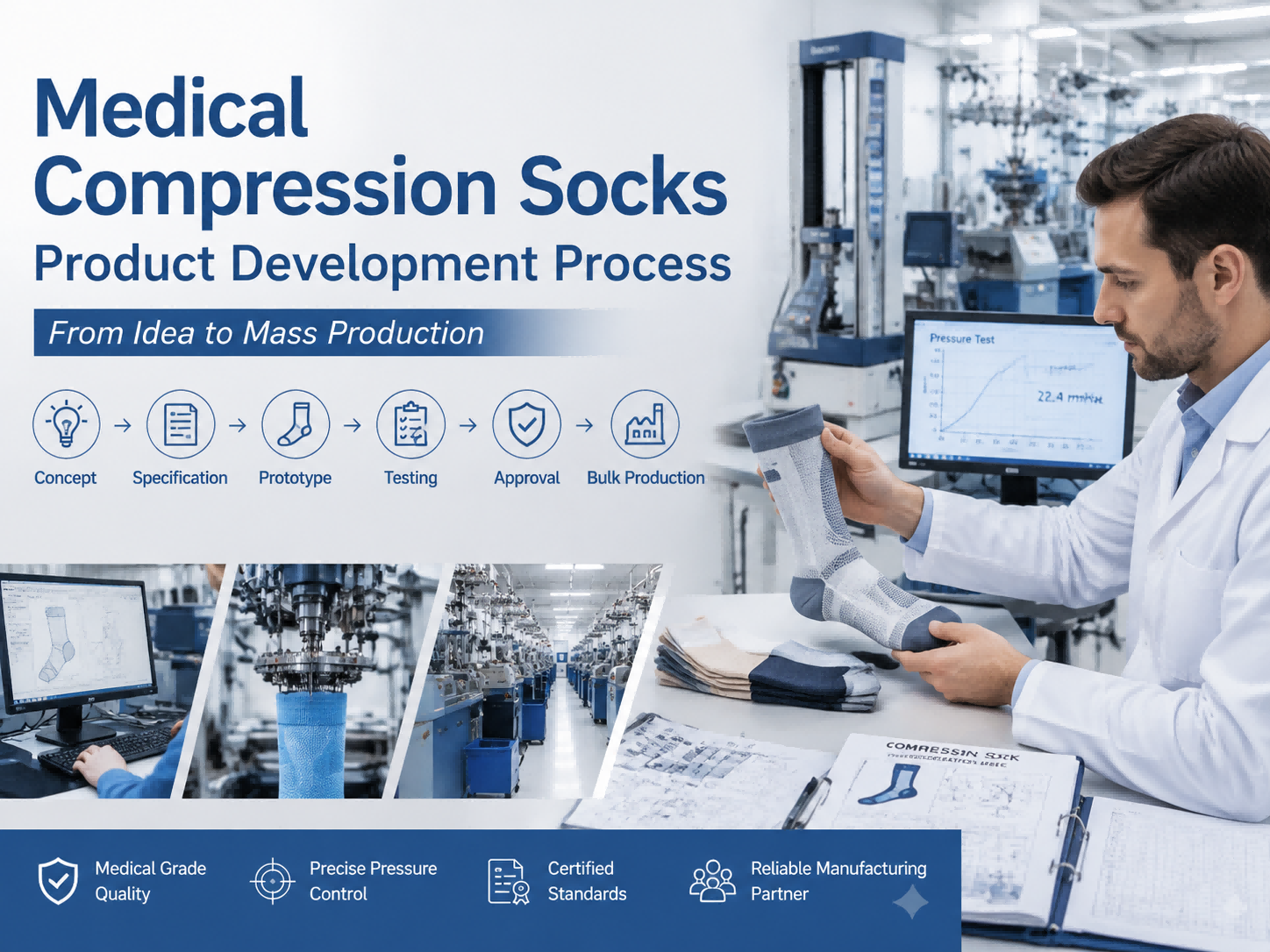
Every time the factory changes to a new design, yarn type, or compression grade, the production line must be shut down for machine calibration. Technicians must program multi-feed circular knitting machines to precisely control the tension of spandex or covered yarns. This setup phase wastes materials and consumes hours of labor. If order volumes are too small, the setup costs can completely eat up profits.
2. MOQ Breakdown by Customization & Compression Levels
Your design choices directly determine your minimum order quantity (MOQ). Here are some variables that affect your required order quantity:
A. Compression Levels (mmHg) & Yarn Requirements
-
Mild/Moderate Compression (15-20 mmHg): Lower MOQ (approx. 500–1,000 pairs). These use standard, readily available elastic yarns that the factory frequently keeps in stock.
-
Firm/Medical Grade (20-30 mmHg & 30-40 mmHg): Higher MOQ (approx. 1,200–2,500 pairs). Achieving true graduated compression requires high-spec specialized spandex and strict quality control. If the factory doesn't have the specific technical yarn in bulk, they must meet their yarn supplier’s MOQ.
B. Aesthetic Customization vs. Functional Customization
| Customization Type | Average MOQ Range | Key Cost Drivers |
| Wholesale / Ready-to-Ship | 50 – 200 pairs | Stocked items, logo added via post-processing (heat transfer/embroidery). |
| Custom Colors & Patterns (Jacquard) | 500 – 1,000 pairs | Requires ordering custom-dyed yarns and re-programming the knitting patterns. |
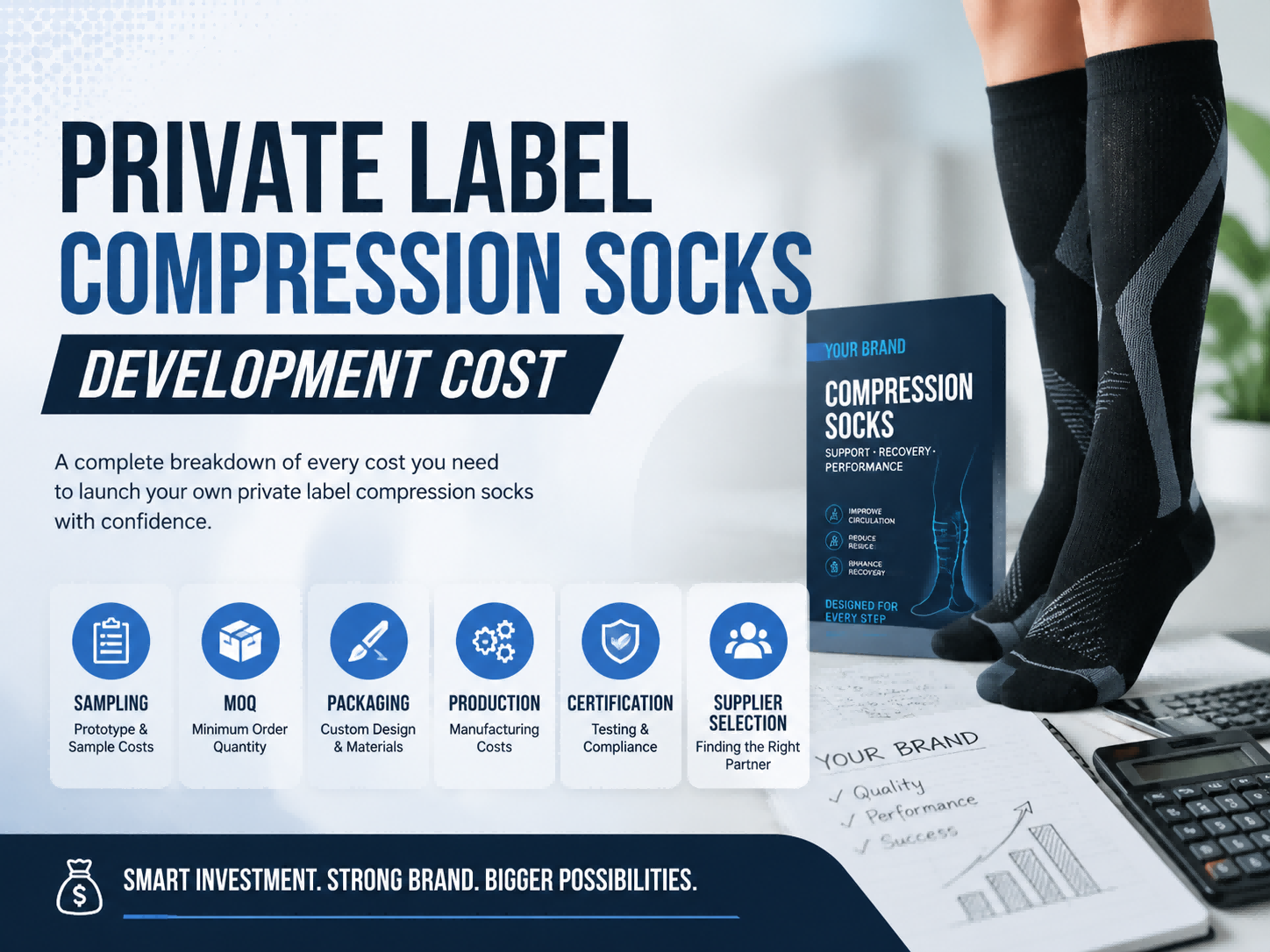
| Private Label Custom Packaging | 1,000 – 5,000 pcs | Printing houses have their own high MOQs for custom paper bands, boxes, or zipper bags. |
3. How Savvy B2B Buyers Navigate High MOQs
If you're launching a new brand or testing a new market, excessively high minimum order quantities can hinder your project. Here are three professional workarounds for negotiating with compression stocking manufacturers:
- Strategy 1: Use the same yarn, but adjust the sizes. Factories are reluctant to change yarn spools, but they don't mind adjusting the sizing scheme. Ask the supplier if the minimum order quantity of 1000 pairs can be divided into three sizes (S, M, L), provided that the color and compression grade remain the same.
- Strategy Two: Stock up on custom packaging first. If you want private label packaging but can't buy 1,000 pairs of socks at once, you can prepay for 1,000 custom retail boxes. The factory can store the boxes in their warehouse and then ship them in batches (200 pairs or 5,000 pairs at a time).
- Strategy 3: Choose to print your logo on blank paper. For quick market testing, you can request "in-stock" inventory from the factory and use high-durability heat transfer technology to print your logo on paper. This minimizes upfront risk while maintaining a professional look.
Looking for a reliable compression sock supply chain partner?
How to Avoid the Most Costly Mistakes When Sourcing Compression Socks from China
Factory vs. Trading Company: How to Verify Your Chinese Compression Sock Supplier
Related Article