Factory vs. Trading Company: How to Verify Your Chinese Compression Sock Supplier
author: carol
2026-05-21

When sourcing compression stockings from China, you may receive numerous seemingly professional quotes. Most suppliers will proudly proclaim, "We are the direct factory."
However, the reality of the Chinese supply chain is quite different. Up to 70% of companies advertising themselves on global platforms are actually trading companies (middlemen) masquerading as manufacturers.
While trading companies have their place, producing technical apparel like progressive compression stockings with middlemen can lead to numerous problems: higher unit costs, poor quality control, lack of FDA/CE certification tracking, and longer delivery times.
If your brand requires a stable, medical-grade compression profile, you need to connect directly with the source. Here is an authoritative and foolproof guide on how to expose the middlemen and find genuine compression stocking factories.
1. Decode the Chinese Business License
In China, all registered companies hold official business licenses issued by the government. While intermediaries can easily forge English certificates, they cannot forge official Chinese registration information.
How to Obtain: Request a clear, high-resolution color scan of your Chinese business license.
How to Verify: Carefully review the "Scope of Business" section.
How to Obtain: Request a clear, high-resolution color scan of your Chinese business license.
How to Verify: Carefully review the "Scope of Business" section.
- Trading Company Characteristics: If the scope of business begins with words like "wholesale," "retail," "import/export," or "trading," the company is likely an intermediary.
- Genuine Factory Identification: A legitimate manufacturer's scope of business will explicitly include words like "production," "manufacturing," "processing," or "knitting."
2. Run a Technical Equipment Check
Gradient compression stockings cannot be produced using standard sock machines. They require specialized, high-precision circular knitting machines capable of controlling precise tension zones (e.g., 15-20 mmHg or 20-30 mmHg).
Middlemen often cannot answer in-depth technical questions about the machines because they are not involved in the day-to-day production operations.
Middlemen often cannot answer in-depth technical questions about the machines because they are not involved in the day-to-day production operations.
Ask your supplier the following three questions:
- "Which brand of circular knitting machine do you use for your compression sock line? Is it Lonati from Italy, Merz from Germany, or a domestic brand?" (The actual factory will answer immediately; intermediaries need to "confirm with their team").
- "What is the needle count of the cylinders in your 20-30 mmHg sports compression socks?" (The standard answer is usually 144N, 168N, or 200N).
- "Could you send me a 10-second smartphone video showing your Salzmann or MST compression testing equipment in action in your testing lab?"
Importance: Genuine medical-grade compression stockings require testing using specialized Swiss Salzmann or MST equipment to verify the pressure drop from the ankle to the calf. Trading companies rarely have access to these expensive calibration devices.
3. Spot the Flaws in "Factory Photos"
Trading companies often steal photos of actual factory products or rent a corner of the workshop to take staged photos. However, as long as you know where to start, you can easily discover the contradictions.
| Look For | Trading Company Photos | Real Factory Photos |
| Company Signage | Often blurred, photoshopped, or missing entirely from the workshop entrance. | Clear, physical permanent signage matching the name on the business license. |
| Worker Uniforms | Workers wearing casual clothing or mismatched safety vests. | Uniformed staff or consistent factory ID badges. |
| Background Details | Pristine, suspiciously clean setups with only 2-3 machines running. | Messy but organized bulk production: rows of machines, raw yarn cones (nylon/spandex), and moving pallets. |
The ultimate trap: Requesting a WeChat or WhatsApp video call during local Chinese working hours (9:00 AM to 5:00 PM GMT+8). Tell them, "Take me out of the office and directly to the production workshop to see the machines running." A genuine factory owner will readily agree. A trading company, however, will use excuses like "factory privacy regulations" or "being too busy" to refuse.
Conclusion: Safeguarding Your Supply Chain
Finding true manufacturing partners requires some upfront investment, but in the long run, it protects your brand reputation, product quality, and profit margins.
As a certified compression sock manufacturer, we manage the entire ecosystem—from raw material sourcing and precise knitting processes to rigorous FDA/CE compliance testing.
Looking to secure a direct manufacturing partner for your brand?
Minimum Order Quantity (MOQ) Guide for Compression Socks: What B2B Buyers Should Know
How to Verify a Compression Socks Factory Quality Before Placing Your First Order
Related Article

Learn what medical brands need to know before launching compression stockings, including compression classes, product types, knee high, thigh high, pantyhose, open toe and closed toe options.
What Medical Brands Should Know Before Launching Compression Stockings
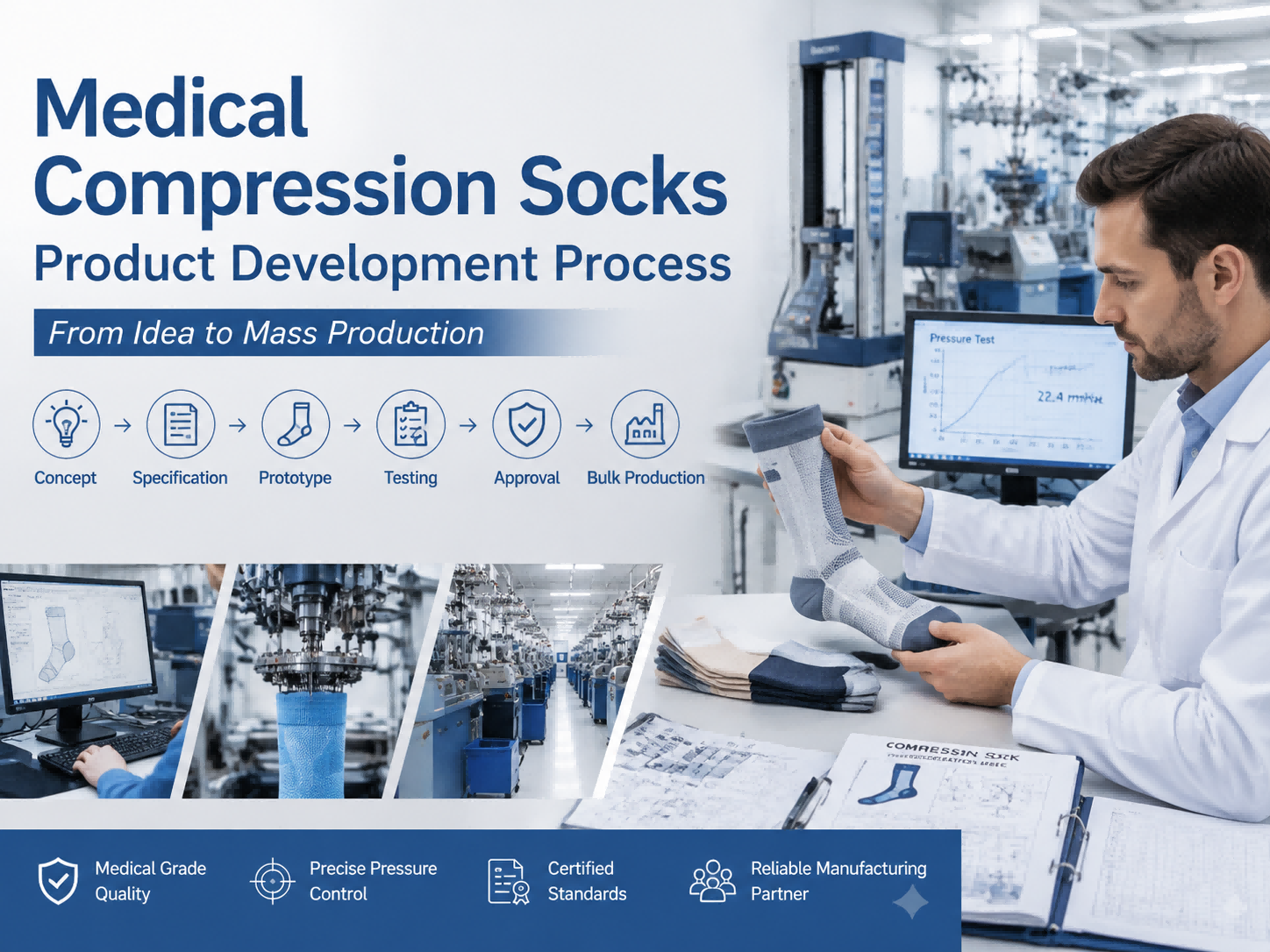
Learn how medical compression socks are developed from concept to mass production. This guide explains each step, including specification design, prototype development, testing, approval, and manufacturing for healthcare companies and medical brands.
Medical Compression Socks Product Development Process
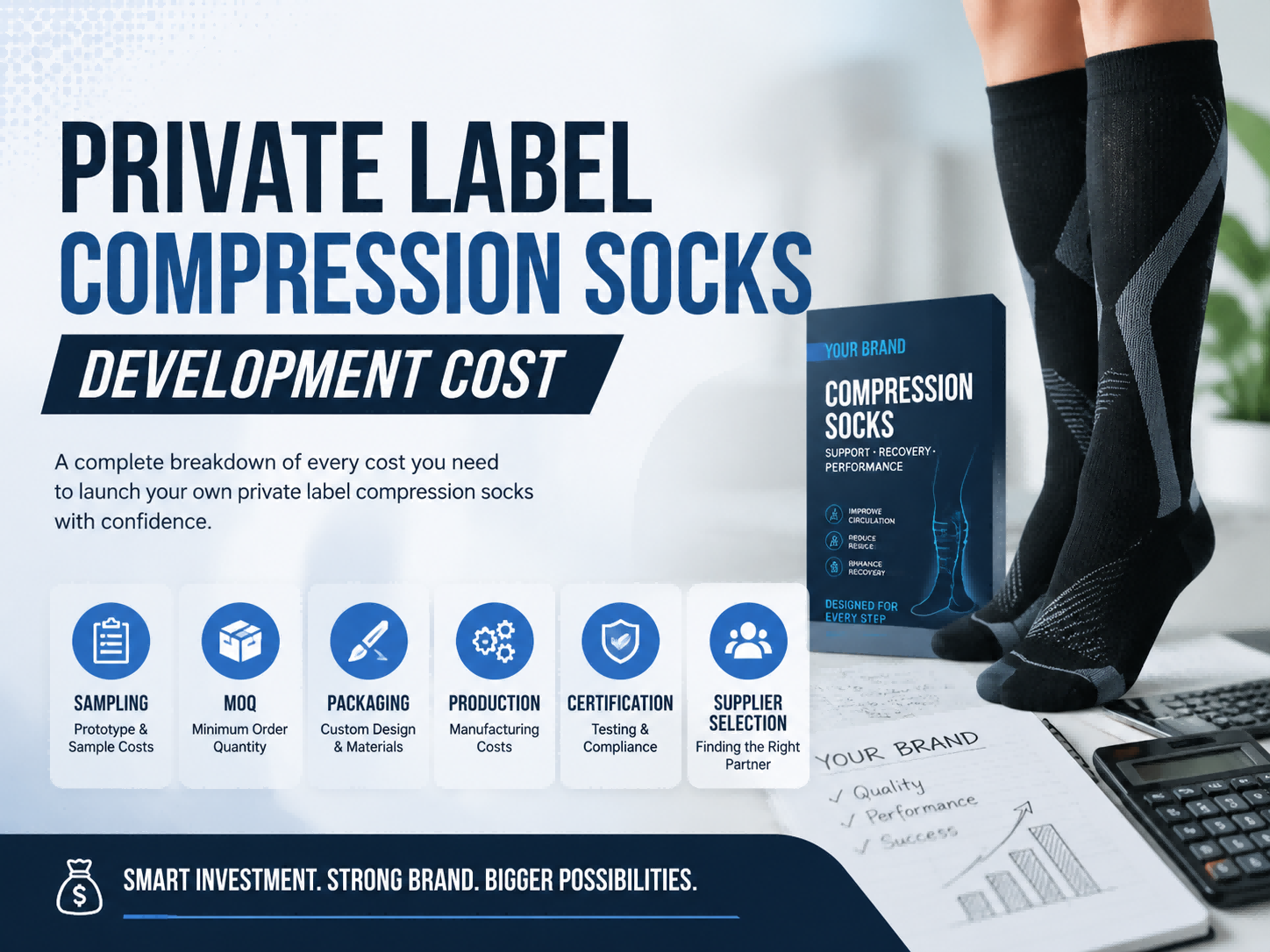
Learn how much it costs to develop private label compression socks, including sampling, MOQ, packaging, production, certification, and supplier selection.
Private Label Compression Socks Development Cost

Starting a compression socks brand requires more than selecting a product. This guide covers the key steps from market research and product selection to supplier sourcing, sampling, branding, and launch preparation. Learn how Amazon sellers, distributors, and healthcare startups can build a reliable compression socks business with the right manufacturing partner and product strategy.
How to Build a Compression Socks Brand in 2026